
Coal-and-clay country, old homes, cold winters
Spray Foam Insulation in New Philadelphia, OH
Spray foam and blown-in insulation for the county seat and the hills around it, priced space by space.
- No-cost estimates at your home, barn or building
- Written price for each space, with material, thickness and R-value
- Leaks, rot and wiring concerns raised before any insulation goes in
Insulation for Tuscarawas County's Oldest City Streets
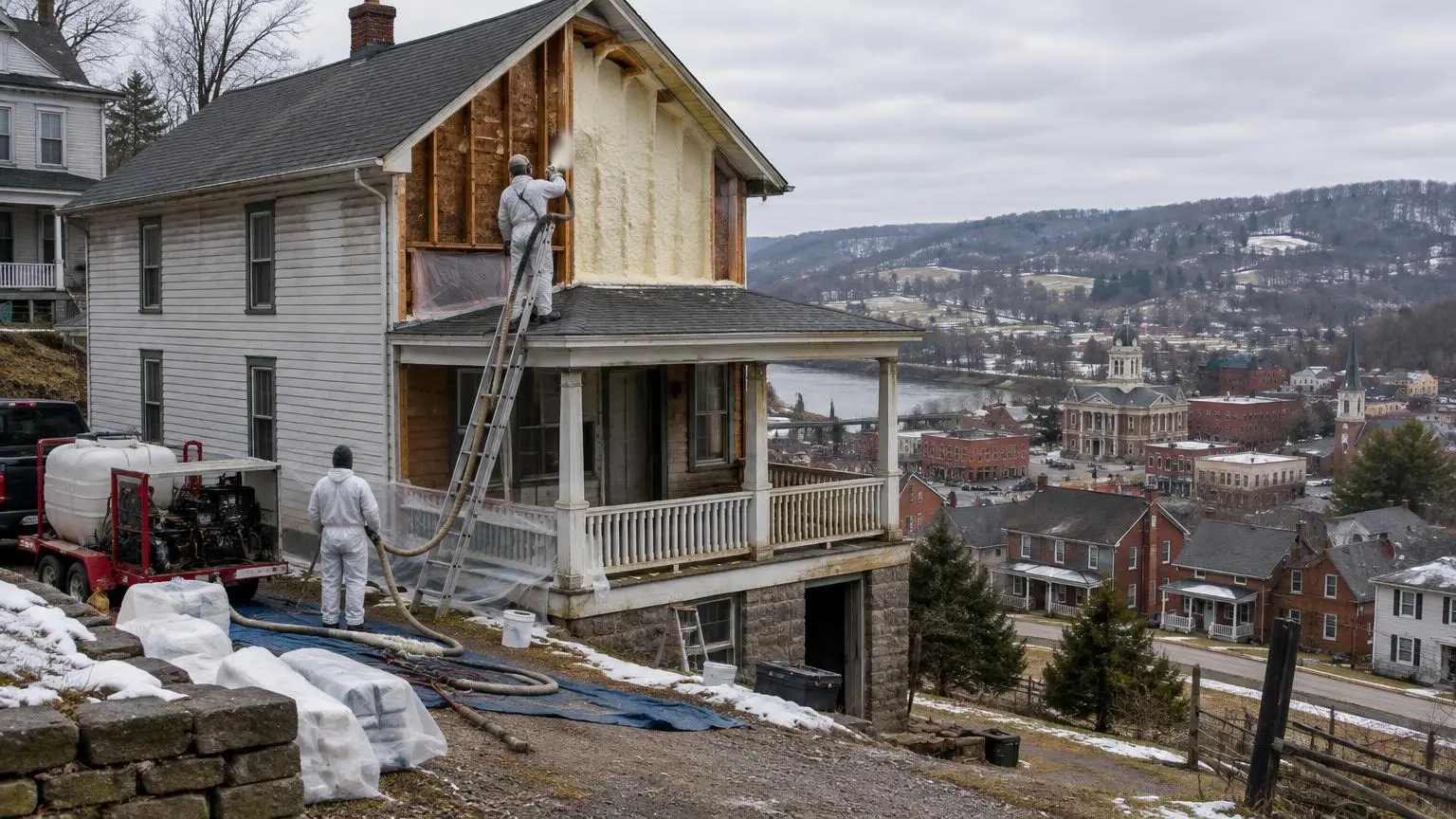
Spray foam insulation in New Philadelphia has a lot of old houses to work with. The city is the Tuscarawas County seat and its largest city, and American Community Survey numbers summarized by Point2Homes show 29.7% of its homes were built in 1939 or earlier and another 10.2% in the 1940s. Wikipedia notes that after the area was resettled in 1804, the presence of coal and clay drove early industry: steel, roofing tile, sewer pipe, bricks, stovepipes and canned goods. The houses built for that workforce were sturdy, but they were built with empty walls and thin attics. As spray foam insulation contractors, we close the air leaks in those homes and add insulation where it counts, with closed-cell or open-cell foam where it pays and blown-in where it is the better value.
The code numbers for eastern Ohio
Every county in our area, Tuscarawas, Harrison, Carroll and Coshocton, sits in Climate Zone 5A under Ohio's residential energy code (Ohio Administrative Code 4101:8-11-01, Table 1101.7). The code's insulation table for that zone calls for R-49 at the ceiling; R-20 in a wood-frame wall, or R-13 in the cavity with R-5 of continuous insulation; R-30 in floors over unheated space; and R-10 continuous or R-13 cavity on basement and crawl space walls. For attics in houses that already exist, ENERGY STAR suggests R-60 where there is no insulation and adding about R-49 over 3 to 4 inches of old material.
Why the old houses here are cold
A house from the 1910s or 1920s usually has plaster on wood lath over stud bays with nothing in them. In balloon-framed houses those bays run from the basement to the attic, so warm air moves up through the walls as if they were flues. The attic has a few inches of rock wool or nothing, and the rim joist sitting on the foundation is bare. Every one of those paths has to be closed before the house will hold heat, and the walls are where these homes differ most from newer construction.
Open cell vs closed cell, and when neither
Closed-cell spray foam is dense and resists water. HomeGuide puts it at about R-5 to R-7 per inch, so it fits shallow spaces and damp ones: rim joists, foundation walls, crawl spaces, metal buildings and roof decks. Open-cell foam is lighter and less costly per inch, about R-3.5 to R-3.7, and it is a good air seal and sound damper in walls opened during a remodel. In a closed plaster wall, neither foam is usually the right answer; dense-packed cellulose blown in through small holes fills the cavity and slows air at a lower cost. Across an open attic floor, sealing plus blown-in also beats foam on price.
Hill country below the house
South and east of the city, homes sit on hillsides with walkout basements, partial crawl spaces and additions on piers. Those mixed foundations are where cold floors and musty smells come from. We seal and insulate crawl space walls with closed-cell foam, cover the ground with a heavy vapor barrier and close the vents, and we foam the rim joist all the way around, including where an addition meets the original house.
Metal buildings and pole barns
Out in the townships, steel buildings serve as shops, garages, equipment storage and barns. A thin steel panel sweats when damp air inside meets it on a cold morning. Closed-cell foam sprayed onto the steel removes that cold surface, so the dripping stops, and it lets the building hold heat in January.
Choosing between insulation companies
When you are calling insulation contractors near you or comparing spray foam insulation companies, ask them to put the details in writing: what foam goes where, how thick, what R-value; what air sealing comes first; how the house is ventilated during spraying and how long you need to stay out (HomeGuide says at least 24 hours); what happens to wet or contaminated insulation; and what each space costs on its own line. Our quotes show all of that.
Spray foam insulation cost
According to HomeGuide's 2026 cost guide, installed spray foam runs $1.50 to $5.00 per square foot, with open-cell from $1.50 to $3.50 and closed-cell from $3.00 to $5.00, and many installers have a job minimum of $1,000 to $2,000 or more. A whole house can run $8,000 to $20,000. Fixr puts foam in existing walls at $3.15 to $7.50 per square foot. Those are national planning numbers; access, thickness, foam type and prep decide your price, and you pay what our written estimate says.
Communities We Serve
We are based around New Philadelphia and work south and east through the Tuscarawas valley and the hills beyond it: Dover next door, Midvale, Uhrichsville and Dennison to the east, the river towns of Tuscarawas, Gnadenhutten and Newcomerstown, and Coshocton where the Tuscarawas meets the Walhonding. East of the county we cover Bowerston and Cadiz in Harrison County and Carrollton in Carroll County. The rail and clay towns have dense older housing; the river towns have Moravian roots and flood history; the Harrison and Carroll county seats sit in coal and gas country. Each town page notes what is different.
- Spray Foam Insulation in New Philadelphia, OH
- Spray Foam Insulation in Dover, OH
- Spray Foam Insulation in Uhrichsville, OH
- Spray Foam Insulation in Dennison, OH
- Spray Foam Insulation in Midvale, OH
- Spray Foam Insulation in Gnadenhutten, OH
- Spray Foam Insulation in Tuscarawas, OH
- Spray Foam Insulation in Newcomerstown, OH
- Spray Foam Insulation in Coshocton, OH
- Spray Foam Insulation in Bowerston, OH
- Spray Foam Insulation in Cadiz, OH
- Spray Foam Insulation in Carrollton, OH

Common Questions
How much should I expect to pay for spray foam insulation?
HomeGuide's national range for installed spray foam is $1.50 to $5.00 per square foot, with closed-cell at the higher end, and job minimums of $1,000 to $2,000 or more are common. For your house, the written estimate we give you after the visit is the price.
Why are people removing spray foam insulation?
Usually because of a bad install (foam that was mixed wrong, shrank or smells), because it was sprayed over a roof leak that later caused rot, or because a renovation needs access. HomeGuide lists removal at about $1.00 to $2.50 per square foot, which is why careful installation matters.
Why do some people call spray foam a red flag?
Mainly because poorly installed foam can hide problems, especially on roof decks, and some inspectors and buyers want to see the deck. We check the roof and framing before spraying and document the work.
Can old plaster walls be insulated?
Yes. We blow dense-pack cellulose into the stud bays through small holes, usually from outside under the siding, then plug and patch them.
How much does a 55 gallon drum of spray foam insulation cost?
Contractors buy two-part foam in drum sets, and pricing varies by product and supplier, so we do not quote material prices. What matters to you is the installed price per space, which we put in writing.
Do we need to leave the house during the work?
For spray foam, yes. HomeGuide advises staying out at least 24 hours. For blown-in insulation, you can usually stay home.
Our Insulation Work
Six services for old houses, newer homes and steel buildings, each priced on its own line.
Spray Foam Insulation
Closed-cell and open-cell foam for rim joists, foundation walls, roof decks and remodels, where foam is worth it.
Learn more →Wall Insulation for Older Homes
Dense-pack insulation blown into the empty walls of pre-war houses, without tearing out plaster.
Learn more →Attic Insulation
Air sealing and blown-in or foam to R-49 or more, for warmer ceilings and fewer ice dams.
Learn more →Basement & Crawl Space Insulation
Closed-cell foam on rim joists, basement walls and crawl spaces, plus vapor barriers for hillside homes.
Learn more →Metal Building & Pole Barn Insulation
Closed-cell foam on steel shops, garages and barns to stop condensation and hold heat.
Learn more →Insulation Removal & Replacement
Removing wet, contaminated or failed insulation, sealing the attic, then reinsulating.
Learn more →
Why Homeowners Call Spray Foam Insulation New Philadelphia
Old-house experience
Plaster walls, balloon framing, stone foundations and additions on piers are the normal job here, not the exception.
Honest material choices
Dense-pack in closed walls, closed-cell where damp or tight, blown-in on open attics. We recommend foam only where it earns its cost.
Inspection before insulation
Roof leaks, rot, wiring and vermiculite are found and flagged before we cover anything.
Line-item pricing
Each space is priced separately so you can compare bids and plan the work in stages.
Get a Spray Foam Insulation Estimate
We inspect the house or building, explain the options and send a price for each space in writing.